Project introduction

This Road of National Significance project will create efficient and reliable journeys through Wellington City, supporting productivity gains and economic growth across the region.

Road of National Significance

December 2025

The SH1 Wellington Improvements project has been identified in the Government Policy Statement on land transport (GPS 2024) as a Road of National Significance (RoNS), to unlock economic growth in the Wellington region. The next stages of work, to investigate and design the project, have been included in the National Land Transport Programme 2024-2027.

Proposed design

The 4-week community engagement on the proposed design ended on 14 December 2025. Extensive engagement continues with our mana whenua partners, councils, landowners, and other key stakeholders.

Community engagement

This page will be updated as the project stages progress.

  • Project type

    Road improvements
  • Project status

    Consenting, Design, Investigation

Subscribe to updates

What does subscribing mean? Please read our Privacy statement


Project overview

The SH1 Wellington Improvements Road of National Significance (RoNS) project will alleviate some of Wellington’s longstanding bottlenecks delivering faster and more reliable state highway journeys and driving regional economic growth. It includes a second Terrace Tunnel, a second Mount Victoria Tunnel, a major roading upgrade at the Basin Reserve, and improvements to the state highway corridor through central Wellington and through Hataitai and Kilbirnie.   

Having an efficient and reliable state highway network is critical to Wellington. It provides people from across the region with access to business, employment and education hubs in central Wellington, as well as Wellington International Airport and Wellington Regional Hospital.   

SH1 through Wellington city is already heavily congested at peak times causing delays and unpredictable journey times and increasing traffic on local roads as people seek alternative routes. Without investment, as the regional population grows, travel times and reliability will worsen, hampering productivity and restricting economic growth.  

In August 2025, the NZTA Board endorsed an investment case for the SH1 Wellington Improvements project and approved funding for the next phase of the project’s development. 

This project is listed in the Fast-track Approvals Act 2024. 


  • Key benefits

    Travel time savings  

    • Up to 10 minutes future travel time savings during peak periods on journeys from the Wellington region to the CBD, hospital, and airport.
    • For public transport users, there is potential for improved travel times between the eastern suburbs and central Wellington, if the number 2 and airport express buses are rerouted through the Mt Victoria Tunnel in future.

    Reliability improvements  

    • Up to 40% improvement in future travel time reliability, providing people and businesses more certainty on journey time. 

    Reduced traffic on local roads  

    • Providing a more efficient state highway attracts traffic away from local roads, unlocking opportunities for wider public transport improvements on these roads.  

    Improved walking and cycling access 

    • A new 3.6m-wide shared path through the second Mt Victoria Tunnel fully separated from traffic.   
    Close
  • Proposed design

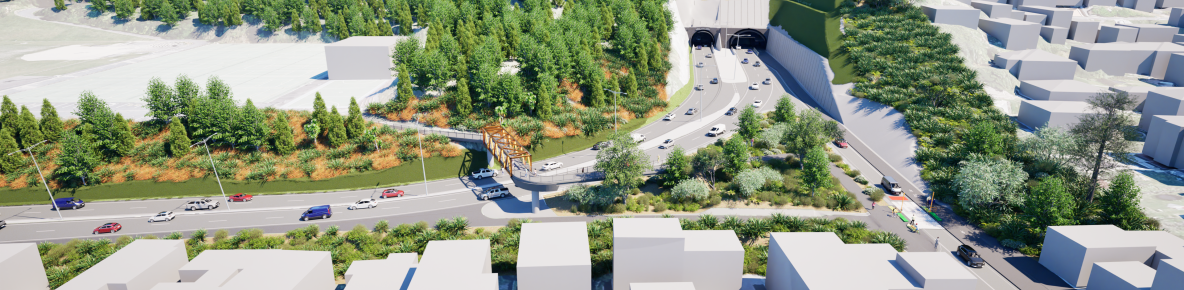
    Key features of the proposed design include:  

    Terrace Tunnel  

    • A second Terrace Tunnel with 2 lanes southbound  
    • Reconfigured existing Terrace Tunnel with 2 northbound lanes and improved safety 
    • Upgrades to the northern and southern approaches  

    Te Aro improvements 

    • 3 lanes on Vivian Street with updates to traffic signals to reduce congestion
    • 3 through lanes on Karo Drive at the Willis Street intersection to improve traffic flow into the Terrace Tunnel  

    Basin Reserve upgrades  

    • Grade separating state highway traffic and local traffic to enable state highway traffic to travel directly from the Mt Victoria Tunnel to the Arras Tunnel  
    • Public transport and walking and cycling connections around the Basin
    • New green link from Pukeahu National War Memorial Park to Cambridge Terrace  

    Mt Victoria Tunnel  

    • A second Mt Victoria Tunnel with 2 lanes eastbound and a 3.6-metre-wide walking and cycling shared path separated from traffic 
    • Retrofit of the existing Mt Victoria Tunnel to create 2 lanes westbound, removing the existing shared path to allow improved safety and wider lanes  

    Ruahine Street and Wellington Road 

    • Widening to provide 2 lanes in each direction
    • New Hataitai Park Bridge over SH1 to improve access
    • Existing footbridge to Hataitai Park replaced and widened for walking and cycling

    View larger image [PDF, 640 KB]

    Close
  • Funding and costs
    • The total investment envelope to design, consent, acquire land and construct the project is expected to be $2.9 to $3.8 billion. This investment envelope includes escalation, contingency and funding risk.
    • The pre-implementation phase (design, consenting and property acquisition) is being funded through the 2024-27 National Land Transport Programme. 
    • Future phases of the project are subject to further funding decisions.
    • The Government Policy Statement on Land Transport (GPS 2024) requires NZTA to consider tolling for all new roads. The SH1 Wellington Improvements investment case proposes tolling to support the construction and maintenance of the project. Once NZTA has completed further planning and design, the next step is to seek approval from the Minister of Transport to proceed to public consultation on tolling.  If approved, public consultation will occur once construction funding is confirmed.
    Close
  • Project background
    • Improvements to State Highway 1 through central Wellington have been the subject of several studies, strategies and proposals in the past.
    • Most recently, work was carried out as part of the Let’s Get Wellington Moving partnership, which identified and developed options for a second Mt Victoria Tunnel and upgrades to the Basin Reserve, as part of a Business Case process.
    • In 2024, this project was then identified by the Government as a Road of National Significance, to be delivered by NZ Transport Agency Waka Kotahi.
    Close
  • Timeline

    How we got here 

    2016 – Let’s Get Wellington Moving (LGWM) Partnership is formed to consider a city-wide transport plan including plans for improvements to SH1 from Ngauranga to the Airport.

    2018 – LGWM Programme Business Case is finalised, including recommendation to upgrade the Basin Reserve and Mt Victoria Tunnel.

    2021-2022 – Indicative Business Case is developed for the LGWM Transformational Programme which includes the Basin Reserve and Mt Victoria Tunnel upgrades. Detailed Business Case phase begins.

    December 2023 – Ministers, Mayor of Wellington and Chair of Greater Wellington Regional Council agree to end the LGWM partnership structure.

    April 2024 – At the request of the Minister of Transport, NZTA begin work to assess the feasibility of a Long Tunnel from north of the Terrace Tunnel to Kilbirnie as an alternative to improve efficiency and reliability of State Highway 1 through Wellington.

    July 2024 – Project identified in the GPS as a Road of National Significance.

    October 2024 – Project included in the draft Fast-track Approvals Bill.

    October 2024 – NZTA Board endorse the preferred option for the project, which includes a duplicate Mt Victoria Tunnel and an upgrade to the Basin Reserve, as well as a duplicate Terrace Tunnel. Investment case phase begins.

    August 2025 – NZTA Board endorse the investment case for the project and approve funding for the pre-implementation phase of development.

    November 2025 – Community engagement on the proposed design opened for 4 weeks, including 6 drop-in community information sessions.

    December 2025 – Community engagement closed. Extensive engagement on the proposed design continues with our mana whenua partners, councils, landowners, and other key stakeholders.

    Close